
In the world of industrial processing, precision is everything. You’ve invested in a high-quality flow meter to monitor your fluids, but there is one installation factor that can make or break your data: straight pipe length.
At Ensetcorp, we often see sophisticated meters providing inconsistent readings simply because they weren’t given enough “breathing room.” Here is why those straight runs are the unsung heroes of flow measurement.
The Problem: Disturbed Flow
Why can’t you just install a flow meter immediately after a pump or a 90-degree elbow? Because piping elements like elbows, tees, valves, and reducers are “flow disruptors.” They transform a smooth stream into a chaotic mess, creating:
Turbulence: Random, jagged fluid motion.
Swirling and Eddies: Circular currents that “trick” the sensor.
Non-uniform Velocity Profiles: Where the fluid moves significantly faster on one side of the pipe than the other.
When the flow passing through the meter is unstable, it no longer represents the true flow rate. This leads to measurement errors that can throw off your entire process.
The Solution: The “Reorganization” Zone
Straight pipe lengths act as a stabilizer. By providing a clear path before and after the meter, you allow the fluid to:
“Reorganize” itself: Smoothing out the chaos from the last bend.
Become symmetrical: Ensuring the velocity is balanced across the pipe diameter.
Stabilize: Entering the meter in a predictable state that matches its factory design conditions.
General Guidelines for Installation
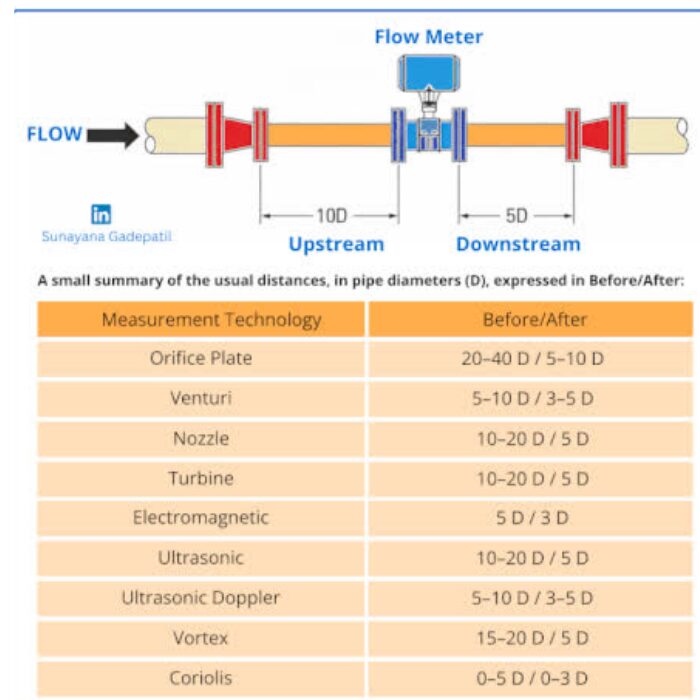
Requirements are usually defined in Pipe Diameters (D). For example, if you have a 2-inch pipe and require 10D, you need 20 inches of straight pipe.
Different technologies handle turbulence differently. Here is a quick reference guide for typical requirements (Upstream / Downstream):
| Flow Meter Type | Before Meter (Upstream | After Meter (Downstream) |
Orifice Plate | 20–40 D | 5–10 D |
Vortex
| 15–20 D | 5 D |
Turbine Meter
| 10–20 D | 5 D |
Ultrasonic (Transit Time)
| 10–20 D | 5 D |
| Flow Nozzle | 10–20 D | 5 D |
| Venturi | 5–10 D | 3–5 D |
| Electromagnetic | 5 D | 3 D |
Coriolis | 0–5 D | 0–3 D |
Pro-Tip: Consult the Manual
While the table above provides a solid baseline, every manufacturer has specific engineering requirements for their specific flow meter model.
⚠️ Important Note: These values are for general guidance only. Always refer to the manufacturer’s installation manual for exact requirements to ensure your warranty and accuracy remain intact.
Looking to optimize your flow measurement system? Contact the experts at Ensetcorp today to find the right meter for your specific piping configuration.

0 Comments